Reaction training
Football reaction training should stay on the ball.Not on a screen.
For players who need quicker first touch, cleaner turns, and faster decisions in tight spaces.
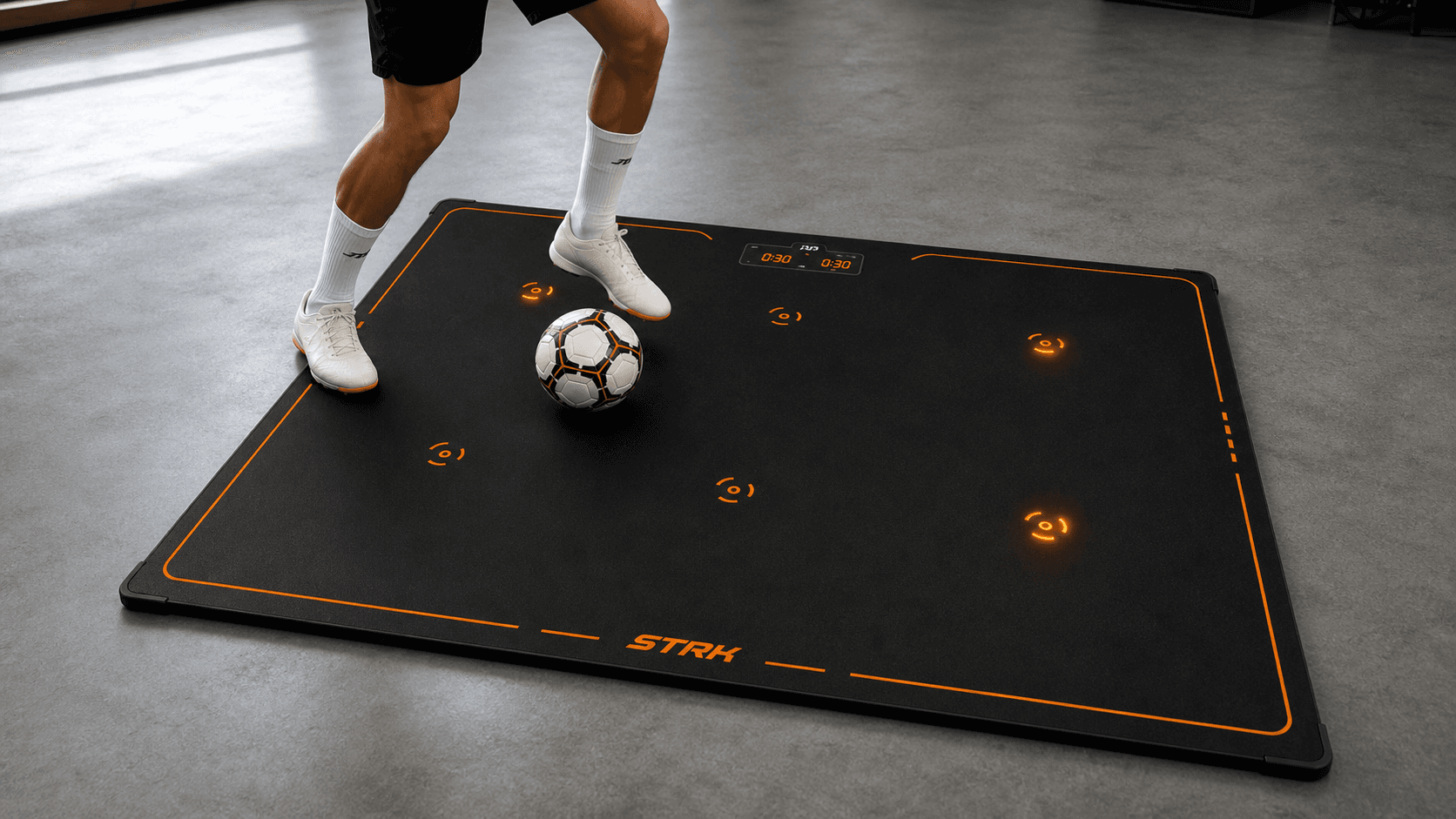
Football Reaction Training
Many reaction tools train the eyes and hands. STRK keeps the decision under the player's feet: a light target appears, the player controls the ball to that zone, then resets for the next cue. The work is still football.
Light cues drive the next touch, but the ball is always moved by the player.
Six target zones create short, match-like direction changes on a compact mat.
Progressions move from clean technique to random timing only after control is stable.
Why reaction work must include the ball
In a match, the player is not only seeing a cue. They are receiving pressure, adjusting body shape, and making the next touch while the ball is moving. STRK makes reaction training practical by linking every cue to a football action.
How the mat changes the session
The mat gives players a clear external target without asking them to stare at a phone. That keeps the head up and the body moving while the feet handle the ball.
Where it fits in training
Use STRK after warm-up for technical sharpness, between strength sets for active skill work, or as a short daily home session when field time is limited.
Session ideas
Make the next touch measurable.
First-touch redirect
Start at the center zone, receive the cue, take one controlled touch toward the light, and stop the ball inside the target.
Inside-outside reaction
Alternate inside-foot control and outside-foot push as targets appear, keeping touches small enough to recover quickly.
Sprint-stop touch
Use longer diagonal targets to train acceleration, braking, and a controlled final touch.
Common questions.
Is football reaction training only about speed?
No. Speed matters, but the useful skill is controlled speed: reading the cue, moving the ball, and arriving balanced enough for the next action.
Can this replace normal football practice?
No. STRK is a focused technical tool for home, academy, and supplemental sessions. Players still need field play, passing, shooting, and match experience.
Keep exploring
Training guides
Clubs, academies, and distribution partners can contact [email protected].